

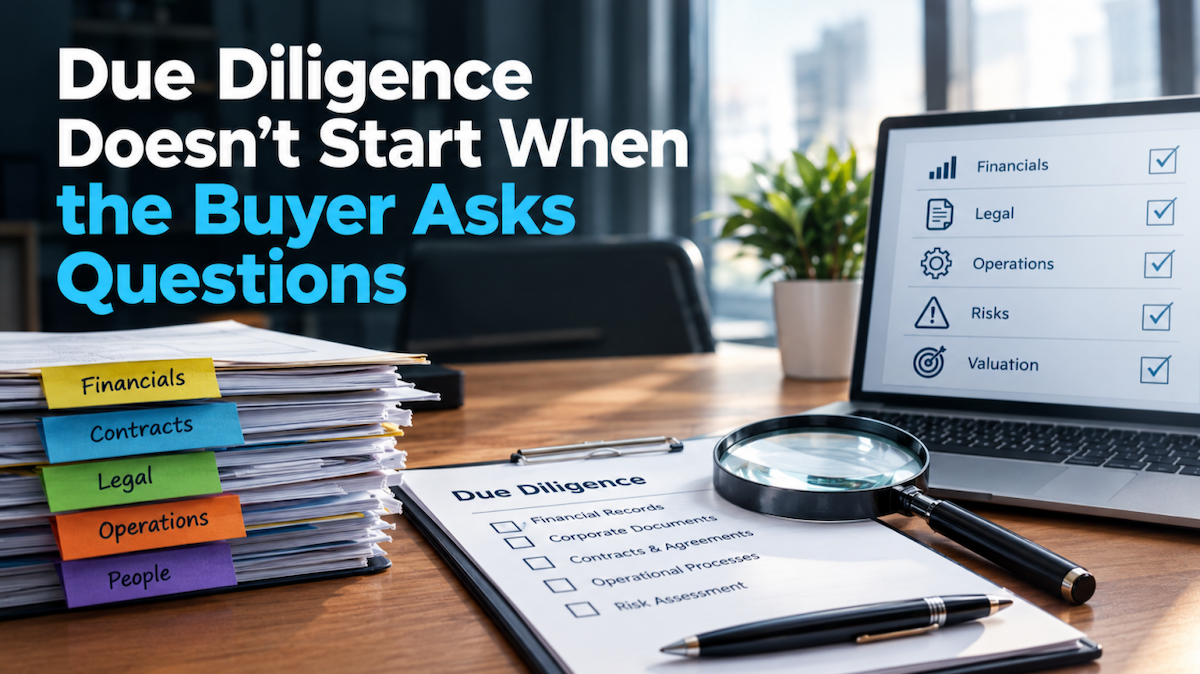
Many business owners believe the hardest part of selling a company is finding a buyer and agreeing on a price. But signing a Letter of Intent is not the end of the process. It is often the point where the real scrutiny begins. This is when the buyer starts looking beneath the surface through a process known as due diligence. And what they discover can determine whether the deal progresses, whether the valuation changes, or whether the buyer walks away.
A buyer doesn’t just want to know what your business has achieved. They want to understand what they are actually acquiring.
Financial records will be examined
One of the first areas a buyer is likely to investigate is the financial history of the business.
- Revenue
- Profitability
- Cash flow
- Debts
- Working capital
- Tax records
- Exceptional or unusual expenses
The numbers need to tell a consistent story.Sudden discrepancies, unexplained transactions or poorly organised financial records can create questions that extend far beyond accounting. If the buyer cannot easily understand the financial performance of the business, they may begin questioning the reliability of everything else they are being shown.
Good financial management isn’t just about running the business. It can also become an important part of demonstrating confidence and credibility during a sale.
Corporate records can reveal hidden problems
Due diligence doesn’t stop with the accounts. Buyers may examine corporate records, ownership structures, contracts, employment arrangements, intellectual property, leases, insurance and other legal or commercial commitments.
Missing documentation may appear insignificant to an owner who has managed the business for years. To a buyer, it can represent uncertainty. And uncertainty creates risk.
The more difficult it is to verify what the buyer is acquiring, the more questions they may have about the transaction.
Operational risks become visible
A business may appear highly successful from the outside while relying heavily on informal knowledge and undocumented processes behind the scenes.
- What happens if an important employee leaves?
- Who manages key customer relationships?
- Where is critical operational knowledge stored?
- How are important decisions made?
- Can another management team understand how the business operates?
During due diligence, these questions can become increasingly important. If essential knowledge exists primarily in the owner’s head, the buyer may question how much of the business’s performance will actually transfer after completion.
Transferability creates confidence
A buyer isn’t simply acquiring your historical performance. They are acquiring the ability to generate future performance.
That means the business needs to demonstrate that its systems, people, processes, customer relationships and knowledge can continue working after ownership changes.
- Documented procedures.
- Clear responsibilities.
- Reliable reporting.
- Strong management capability.
- Repeatable processes.
These aren’t simply operational improvements. They are evidence that the business can function as an independent asset rather than remaining dependent on the person who built it.
Hidden liabilities can change the deal
One of the purposes of due diligence is to uncover risks that may not be immediately visible.
- Outstanding obligations
- Contractual restrictions
- Customer concentration
- Supplier dependency
- Employment issues
- Operational weaknesses
- Unresolved disputes
These issues don’t necessarily mean a transaction will fail. But they can change how a buyer views the risk associated with the acquisition. And increased perceived risk can affect the structure, terms or valuation of a deal.
Preparation should happen before the buyer arrives
The biggest mistake is treating due diligence as something that begins after receiving an offer. By that point, there may be very little time to fix years of accumulated problems.
Instead, preparation should begin while you still have control over the timeline.
- Clean up the financial records
- Organise corporate documentation
- Review contracts
- Document critical processes
- Identify operational dependencies
- Strengthen management capability
- Conduct an internal review of potential risks
The objective isn’t to make the business look perfect.
It is to understand the business well enough to address weaknesses before someone else discovers them.
Build a business that can withstand scrutiny
A buyer’s due diligence should not be the first time you discover the weaknesses in your business. If you conduct your own internal audit years before a potential transaction, you have something a buyer doesn’t have:
Time.
- Time to fix problems.
- Time to strengthen systems.
- Time to improve financial visibility.
- Time to reduce owner dependence.
- Time to build a stronger management team.
- Time to create evidence that the business can operate without you.
That preparation can make the eventual transaction more predictable and the business easier for a buyer to understand.
Don’t wait until you’re under scrutiny to become due diligence ready
The strongest preparation happens long before the Letter of Intent is signed, because due diligence doesn’t create the weaknesses in a business.
It reveals them.
- Build the systems before they’re questioned.
- Organise the records before they’re requested.
- Identify the risks before a buyer discovers them.
- And build a business that isn’t simply ready to be sold.
Build a business that a buyer can confidently take over.