
Many business owners believe that if their business is profitable, has loyal customers and enjoys a strong reputation, it should naturally attract a buyer or investor. But there is an important distinction between running a good business and building an investible one.
A business can perform well for years and still struggle to attract investment, achieve its expected sale value or convince a buyer that it is worth acquiring. Why? Because what makes a business successful for its owner is not always what makes it attractive to someone else.
An owner understands the history, the relationships, the challenges overcome and the decisions that keep everything moving. An outside investor sees something different.
They see risk, return and the reliability of future earnings. And if too much of the business depends on the person who built it, that can become a significant barrier to investment or a successful exit.
A profitable business still needs to prove its value
Profitability matters. But it is only part of the picture. A buyer or investor needs to understand how the business generates its profits, whether those profits are sustainable and what might happen when ownership changes.
Consider two businesses generating similar annual profits.
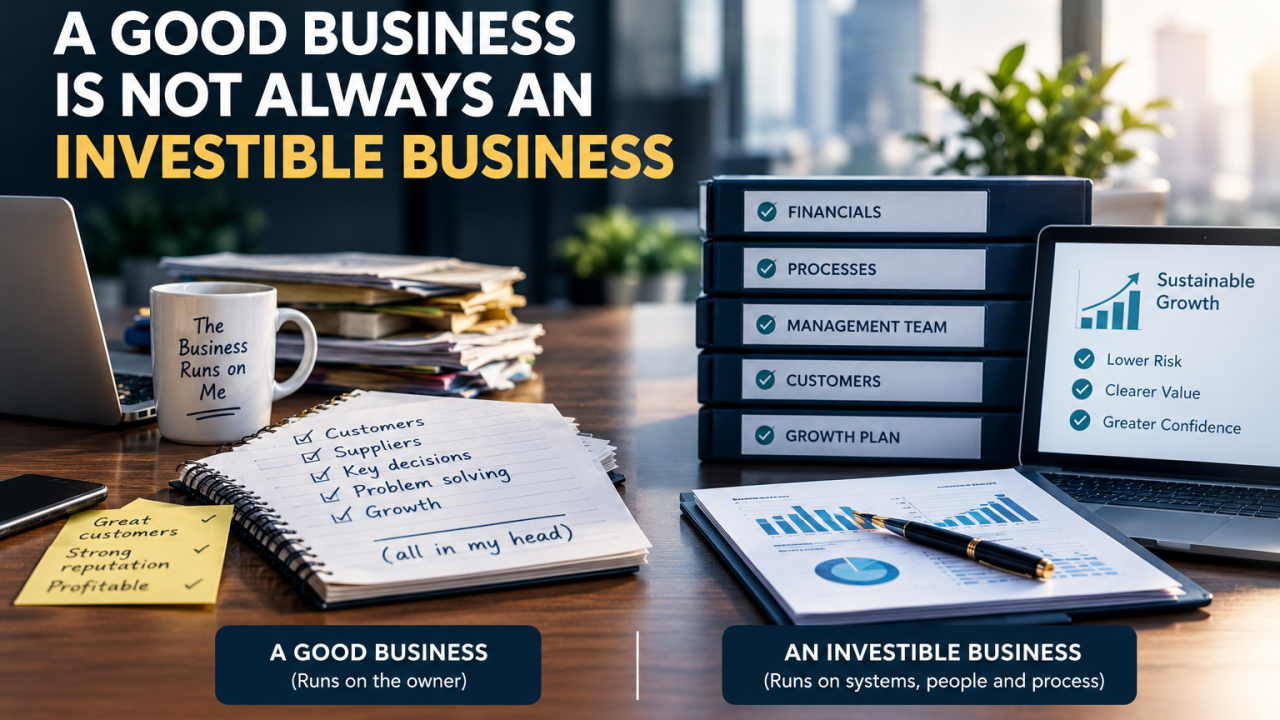
The first has loyal customers, but the owner manages the key relationships, approves important decisions, solves operational problems and holds most of the business knowledge.
The second has documented processes, an experienced management team, reliable financial reporting and established customer relationships that do not depend on one individual.
Both businesses may be profitable. But the second gives an outside investor greater visibility into how the business operates and how its performance might continue after an acquisition.
The difference isn’t necessarily what the businesses earn today.
It is how confidently a buyer can assess what they will be acquiring tomorrow.
Can an outsider understand your business?
One of the biggest obstacles to investment is complexity that exists only inside the owner’s head.
You may know which customers are most profitable, why margins fluctuate, which suppliers are essential and how to resolve problems when they arise. But can someone else understand those things without asking you?
An investible business should be able to demonstrate:
- Reliable financial information: Clear reporting that explains revenue, margins, profitability and cash flow.
- Documented systems: Processes that allow work to be completed consistently without relying on the owner’s memory.
- Leadership beyond the owner: A capable team that can manage daily operations and make decisions.
- Predictable revenue: Greater visibility into future income through recurring contracts, repeat customers or other dependable revenue streams.
- A credible growth strategy: Clear opportunities for growth supported by evidence, resources and a realistic plan.
- Reduced dependency: Customer relationships, operational knowledge and decision-making that are not concentrated in one person.
These are not simply good management practices. They help an outside party understand the business, assess its risks and evaluate its future potential.
If an investor needs the owner to explain every important detail, the business may not yet be ready for investment.
Your history is not the buyer’s investment case
Business owners understandably place enormous value on what they have built. They remember the difficult years, the personal sacrifices, the risks taken and the relationships developed over time. That experience matters. But a buyer cannot acquire your history. They are investing in the future performance of the business.
They want to know whether customers will stay.