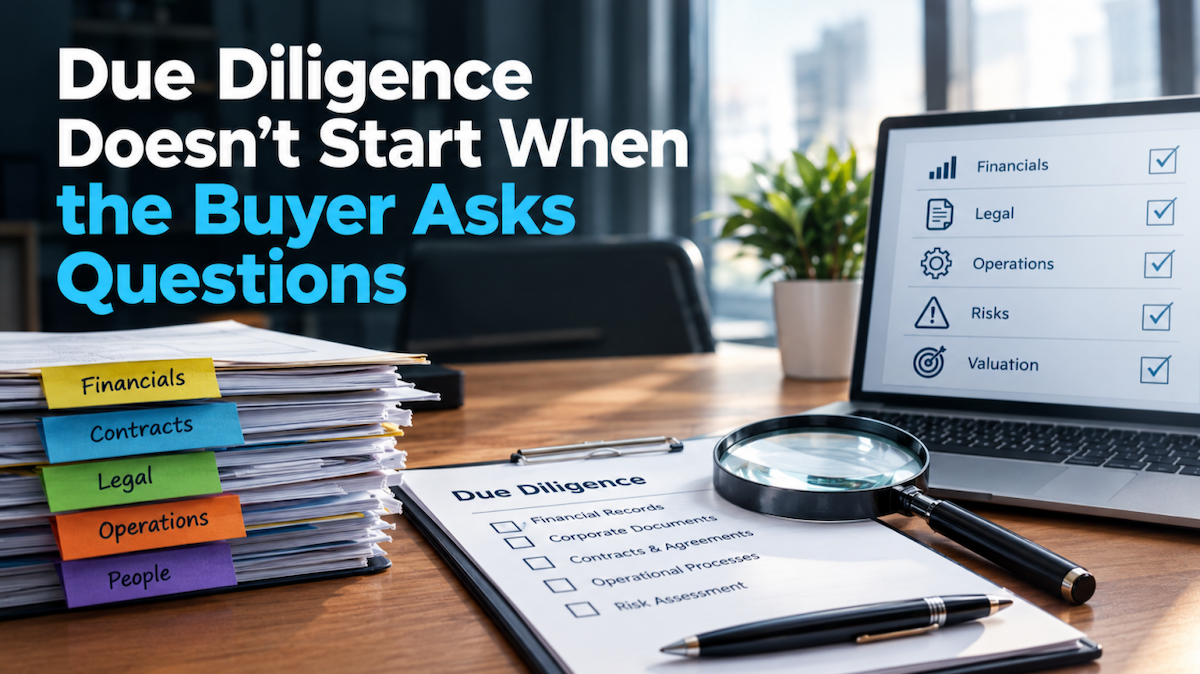

A strong business is not necessarily a valuable business.
Revenue, profit and growth may look impressive on paper, but when a buyer evaluates your company, they are really asking a different question: “What am I actually buying, and how predictable will it be after the owner leaves?” That distinction matters.
Buyers are not simply investing in your historical performance. They are investing in the future cash flow, predictability and independence of the business. The more risk they see, the more likely they are to protect themselves through a lower valuation.
This is why maximising valuation is not just about growing revenue. It is about building a business that can operate, perform and grow without being dependent on you.
Predictable revenue creates confidence
Recurring and stable revenue is one of the clearest signals of future predictability.
A business that relies heavily on one-off sales, inconsistent customer demand or a small number of key accounts can create uncertainty for a buyer. Even if the current numbers look strong, the question becomes: how much of that revenue can realistically be relied upon in the future?
Recurring revenue changes that conversation.
When customers continue buying, contracts renew and revenue can be forecast with greater confidence, the business becomes easier to understand and potentially less risky to acquire.
Clean financials protect your valuation
Your accounts are not simply a record of what happened. They are evidence of how well the business is managed.
When financial records are accurate, consistent and easy to understand, buyers can assess performance with greater confidence. When numbers are unclear, poorly categorised or difficult to reconcile, uncertainty creeps into the deal. And uncertainty has a price.
The cleaner your financial information, the easier it becomes to demonstrate the underlying strength of the business and defend the valuation you are asking for.
Systems turn your business into an asset
A business that exists primarily inside the owner’s head is difficult to transfer.
If employees rely on you for decisions, processes are undocumented and critical knowledge sits with one person, a buyer is not simply acquiring a business. They are inheriting operational risk.
Documented systems change that. Clear processes create repeatability. Repeatability creates consistency. And consistency makes the business easier for someone else to operate.
The goal is to create a blueprint for how the company works, rather than relying on the founder to personally hold everything together.
Independence increases transferability
Perhaps the biggest question a buyer will ask is: “What happens when you are no longer here?”
If revenue drops, customers leave, employees become uncertain and decisions grind to a halt without you, the business has a dependency problem. But if the team can operate effectively, customers have relationships with the company rather than just the founder, and the systems continue working without daily intervention, the business becomes far more transferable. That is the difference between owning a job and owning an asset.
Valuation is built before you decide to sell
The biggest mistake owners make is waiting until they want to exit before thinking about valuation. By then, it may be too late to fix years of owner dependence, inconsistent revenue, weak documentation or messy financial records. The strongest exits are built long before the business goes to market.
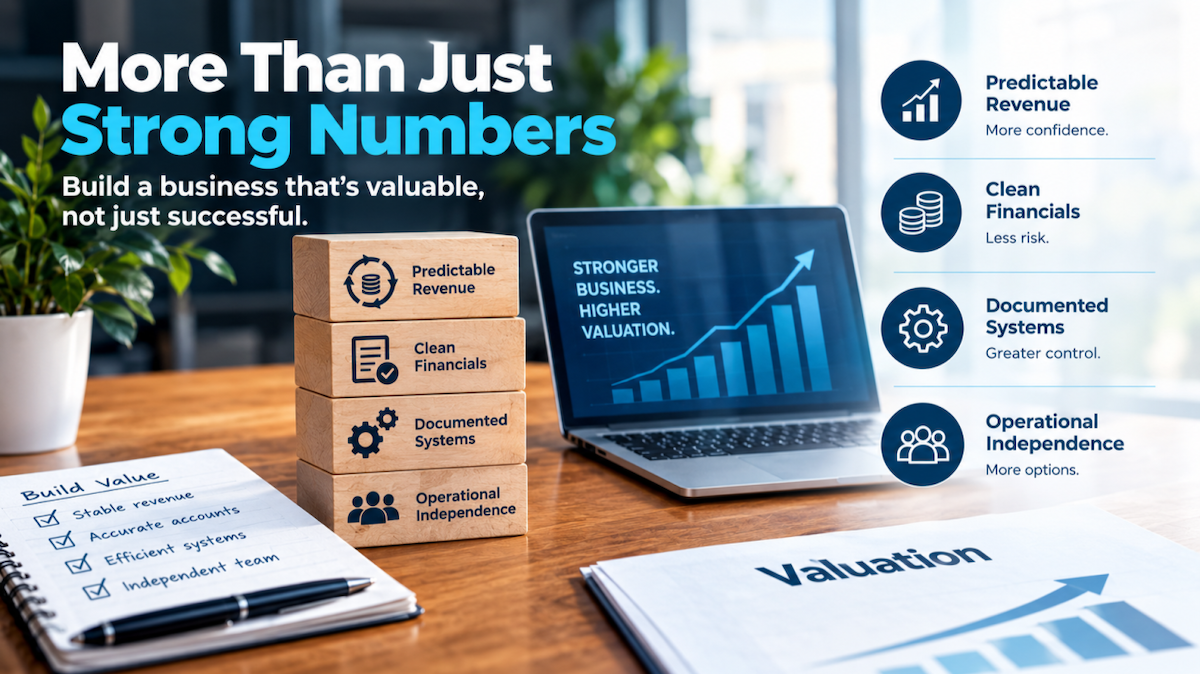
Focus on four things: predictable revenue, pristine financials, documented systems and genuine operational independence. Because ultimately, buyers are not just buying what your business has achieved. They are buying what they believe it can achieve without you.